
Le Ray Previous Residents by Era
A backward address trail has several layers. The parcel establishes the property identity. The recorded deed trail identifies parties to transfers. Historical directories can add a dated residence or street listing, and census schedules help describe a household at a public-release interval. None of these sources alone proves continuous occupancy. For Town of Le Ray, the most useful record groups are held by Jefferson County, state archives, Flower Memorial Library, and the town's planning or zoning channels.
| Source | Years it covers | Where held | What it shows |
|---|---|---|---|
| Jefferson County deed series | 1793-present | County Clerk / Records Center; SearchIQS online availability documented from 2014 | Recorded parties, instrument date and type, legal description |
| County map files | Current files and back file to 1959 | County Clerk and Records Management | Map and parcel-geometry clues |
| Watertown City Directories | 1840 and non-consecutive 1855-1916 | Flower Library and NY Heritage | Regional street, residence, business, and institution entries |
| NYS vital indexes | Births 1881-1937; marriages 1881-1960; deaths 1880-1960 outside NYC | NYS Archives and Flower microfiche | Name, date, place, and certificate-number leads |
| Federal census | Public schedules follow the 72-year rule | National Archives and library routes | Household, age, and place snapshot |
Start with the source nearest the date in question. A recent transfer is usually a county land-record question. An early household lead may begin with a directory or index, then move to a county request or archive record. No searchable public Le Ray permit archive was located. For a construction or project trail, give the town planning or zoning office the address, parcel, project type, and date range in a records request.
Note: A record's coverage range describes the collection, not a guarantee that every address or year will appear in it.
Le Ray Deed Chain Backward
For previous residents research, the deed chain begins with the current parcel, not an assumed person. The Jefferson County parcel and tax portal can be searched by Tax Map Number, owner name, or address. It supplies a property-record lead that should be recorded with the tax-map number, situs address, municipality, assessment or tax year, and search date. The owner field describes a property relationship. It does not establish who occupied the address.
- Search the Jefferson County parcel and tax lookup by address, name, or Tax Map Number, then preserve the parcel identity and situs address.
- Find the most recent recorded instrument through Jefferson County SearchIQS or by self-search at the County Clerk's office.
- Read the legal description, recording date, instrument type, and the grantor and grantee roles before attaching a name to the property.
- Search the prior seller as a grantee, compare the legal description, and repeat only while the parcel and party trail remain consistent.
- When the online trail stops, use the office, Records Center, or a narrow search request for older index or deed-book work.
- Grantor and grantee
- The grantor transfers an interest in the recorded instrument; the grantee receives it. Their roles can reverse when the chain is followed backward.
- Chain of title
- The sequence of recorded transfers and related instruments tied to one parcel. It is not the same thing as a conclusion about current occupancy.
- Legal description
- The parcel description carried in the recorded instrument. It can outlast a changed street label and is often stronger than an address alone for older work.
SearchIQS and Le Ray Previous Residents
Jefferson County records show an important access split. The deed series is documented from 1793 to the present, but SearchIQS online availability is documented from 2014. SearchIQS offers guest or subscription access under the county's current fee schedule. The live result fields were not captured in the research, so no result-column claim should be assumed. The online tool is an entry point, not the full history of every Le Ray parcel.
The alternative channel is meaningful: the County Clerk allows free public self-search in the office, though copies cost money. For a staff search, use the Jefferson County search and copy request route or the county records-search form with the narrowest name, year range, and document type available. The form supports categories such as deeds, mortgages, maps, naturalizations, assumed names, judgments, and other records. A careful request makes an older trail easier to locate and limits false matches.
Note: Confirm current search, copy, and subscription charges with the County Clerk before requesting a paid service.
Le Ray Previous Residents Need Parcel Clues
Street addresses are useful, but they can mislead a house-history search. A tax record may show a mailing address that differs from the physical situs address. The mailing address is a lead for the recorded party. The situs address ties the parcel to the county GIS and tax-map system. Keep both fields, but do not treat either as a list of past residents. When names, spouse information, parcel details, or roles diverge, pause rather than merging two similarly named parties.
The Jefferson County GIS and property-search gateway connects the parcel and map layers. County documentation identifies aerial imagery, zoning, school and election information, flood data, agricultural districts, land use, and other planning layers. A map is an address and geography check. It cannot confirm a household by itself. Compare its source date with the deed date and with the actual street spelling in a historical record.
Note: A map clue, mailing label, and parcel owner field answer different questions. Preserve them separately before drawing any conclusion about who lived at the address.
Le Ray Past Residents in Directories
Recorded transfers identify parties, but past residents are often found in dated household sources. The Flower Library and NY Heritage Watertown volumes are regional evidence, not a verified Le Ray directory series. Their value lies in the address-to-name structure of the 1902 volume and in the available alphabetical, street, business, government, and institution sections. A printed Watertown address can suggest a move, a trade, or a surname variation, but it needs a separate Le Ray connection.
The NY Heritage Watertown directory collection has non-consecutive titles from 1855 through 1916 and an item inventory that also exposes an 1840 volume. Read the scan, not just OCR. The 1902 preface warns that errors may remain, and its abbreviation key uses marks such as h for house, res. for residence, rms. for rooms, bds. for boards, and wid. for widow.
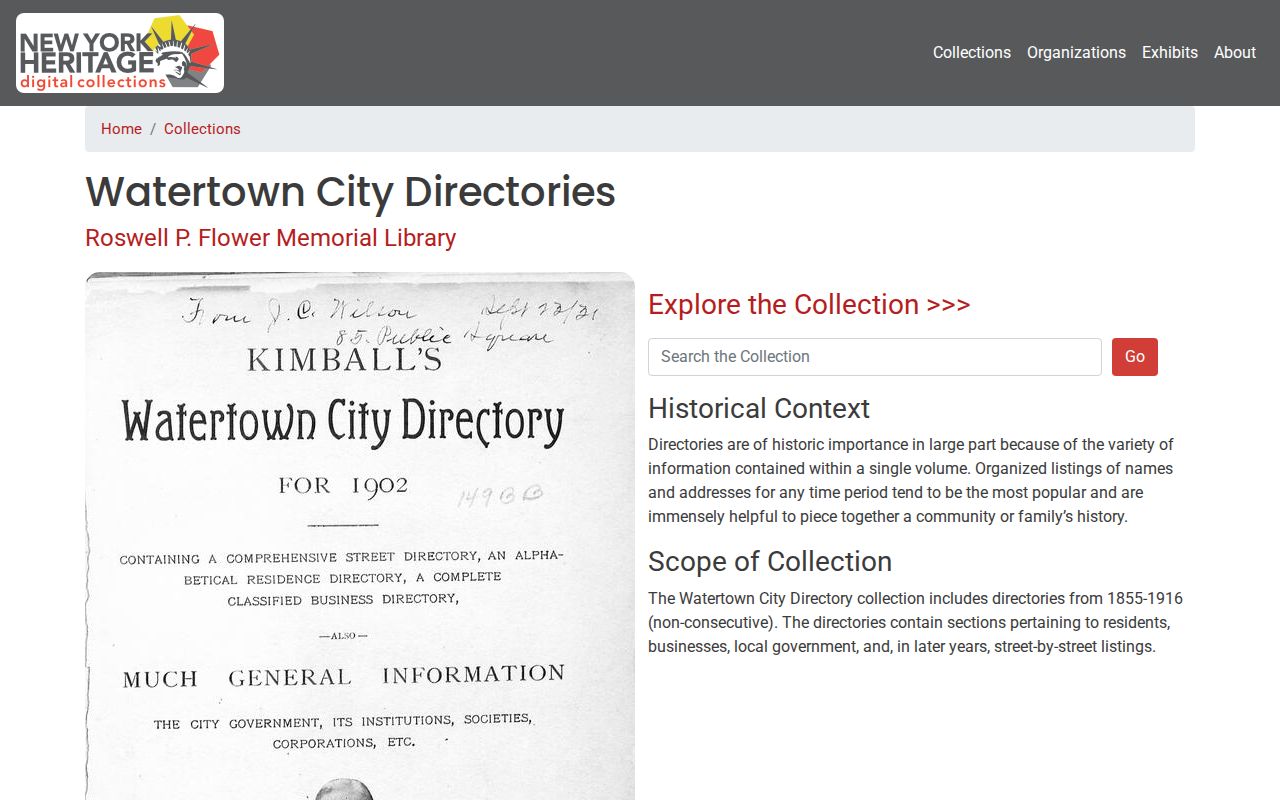
The scan lets an address-history researcher retain the original spelling, page context, and abbreviation rather than relying on a flattened text result.
Note: A Watertown directory entry is regional evidence and needs a separate Le Ray connection before it supports a town-residence claim.
Le Ray Previous Residents Between Censuses
Federal schedules are public under the 72-year rule, so they are best used as dated household snapshots. City directory years can fill an interval, but their inclusion rules differ and the available regional volumes are not consecutive. A person missing from a directory may have moved, died, been omitted, appeared under another household label, or fallen into a gap in the publication run. Do not turn a blank into a fact.
Use a simple sequence: address and parcel to deed trail, dated directory entry to census household, then vital-index or obituary lead to test a change. The Town of Le Ray city directories collection explains how the regional volumes read; here the goal is to place each entry at the right point in one address history. If a residence line conflicts with a deed, preserve both citations and look for a third dated record instead of choosing the more convenient answer.
- Set a dated deed or parcel event as the anchor for the address.
- Locate the closest available directory year and transcribe its place, address, and relationship marks.
- Compare that interval with the available federal census household.
- Test a move or death with an eligible vital index, obituary lead, probate route, or later deed.
Le Ray Map History Has Different Starts
Digitized does not mean every historical record begins online on the same date. The county's map back file reaches to 1959, while deeds are documented from 1793. SearchIQS online access is documented from 2014, and the county reported a map scanner in 2016 plus a book scanner in 2023 for deeds, mortgages, naturalizations, and other material. Those milestones improve access, but they do not prove that a particular early instrument or map can be searched from home.
County digitization was also described in a 2025 local report as work preserving maps, deeds, court records, and older books. Treat that as a reason to ask Records Management whether a named deed, map, naturalization packet, or survey book has been scanned or is onsite. It is not a reason to assume an unreturned search has no record. This access gap is especially important for previous residents research that crosses several decades.
Flower Library for Le Ray Past Residents
Flower Memorial Library is the local genealogy route when a deed trail needs a household or obituary follow-up. The genealogy department serves Jefferson County and nearby counties, has a microfiche reader, and lists a telephone route for appointments. Its documented service includes in-house searches described as free, copies at $0.20 per page plus postage, a detailed mail request with a self-addressed stamped envelope, plus email and telephone for brief questions. Confirm hours and copy charges before relying on them.
The Flower Memorial Library genealogy desk is the appropriate named contact for local newspaper microfilm and obituary leads because no complete official Le Ray obituary index was located. Give the staff the surname, approximate date, town or place, and the kind of record sought. For a county-history context question, Paddock Mansion's historical-society collections are a separate route, while genealogy inquiries are directed to Flower.
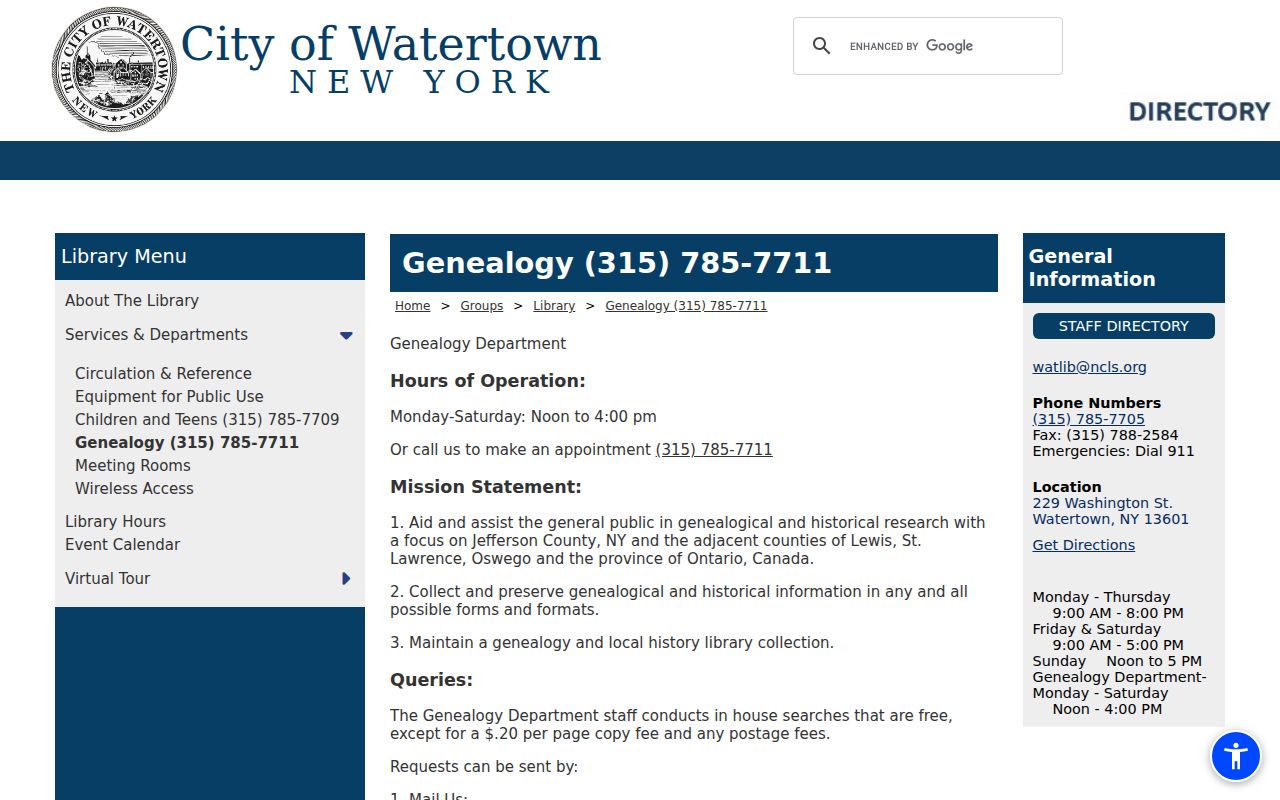
Library research can connect a property record to a dated household lead, but the copied source and its date should remain with every conclusion.
Note: A surname, year range, place, and record type help the library identify the most useful local-history source.
Le Ray Previous Residents Need Proof
Past residents research is strongest when it serves family history, estate or heir work, a documented property history, or personal curiosity about a place. It should never be used to contact, track, or harass a living person. New York also has address-confidentiality and confidential-voter protections. If a record shows a substitute or protected address treatment, do not attempt to reconstruct the protected information from other sources.
A historical vital index can point to a record without granting access to a certificate. New York's genealogy route generally opens birth records after 75 years when death is known, death records after 50 years, and marriage records after 50 years when both spouses are known deceased, with a direct-line exception requiring proof. The NYS Archives vital-record guidance and the issuing custodian distinguish an index from an eligible copy request.