
Le Ray City Directory Holdings
There is no confirmed all-town historical series for Le Ray in the material reviewed. The strongest directory shelf is the regional Watertown collection from Roswell P. Flower Memorial Library. It can help with Jefferson County surnames, trades, old address patterns, and a move toward or away from Le Ray. It cannot turn a Watertown listing into a Le Ray residence. Record the place printed in the volume, then seek a deed, census entry, vital index, or local source before making that connection.
| Collection | Years | Where held | Access |
|---|---|---|---|
| Watertown City Directories | 1840 and non-consecutive 1855-1916 | Flower Memorial Library and NY Heritage | Digital browse and library research |
| 1902 Watertown directory | 1902 | NY Heritage / ContentDM | Scanned street and residence sections |
| NYS vital-index microfiche | Births 1881-1937; marriages 1881-1960; deaths 1880-1960 outside NYC | NYS Archives and Flower Library | Index and local microfiche route |
| Jefferson County naturalization list | 19th- and 20th-century entries; index updated 2017 | County Clerk / Records Management | Public index, underlying file by request |
The NY Heritage directory collection is the online starting point for the regional volumes. Its collection summary describes 33 items and a non-consecutive run beginning in 1855, while the item inventory also exposes an 1840 title. Preserve that mismatch in research notes instead of silently choosing one start date.
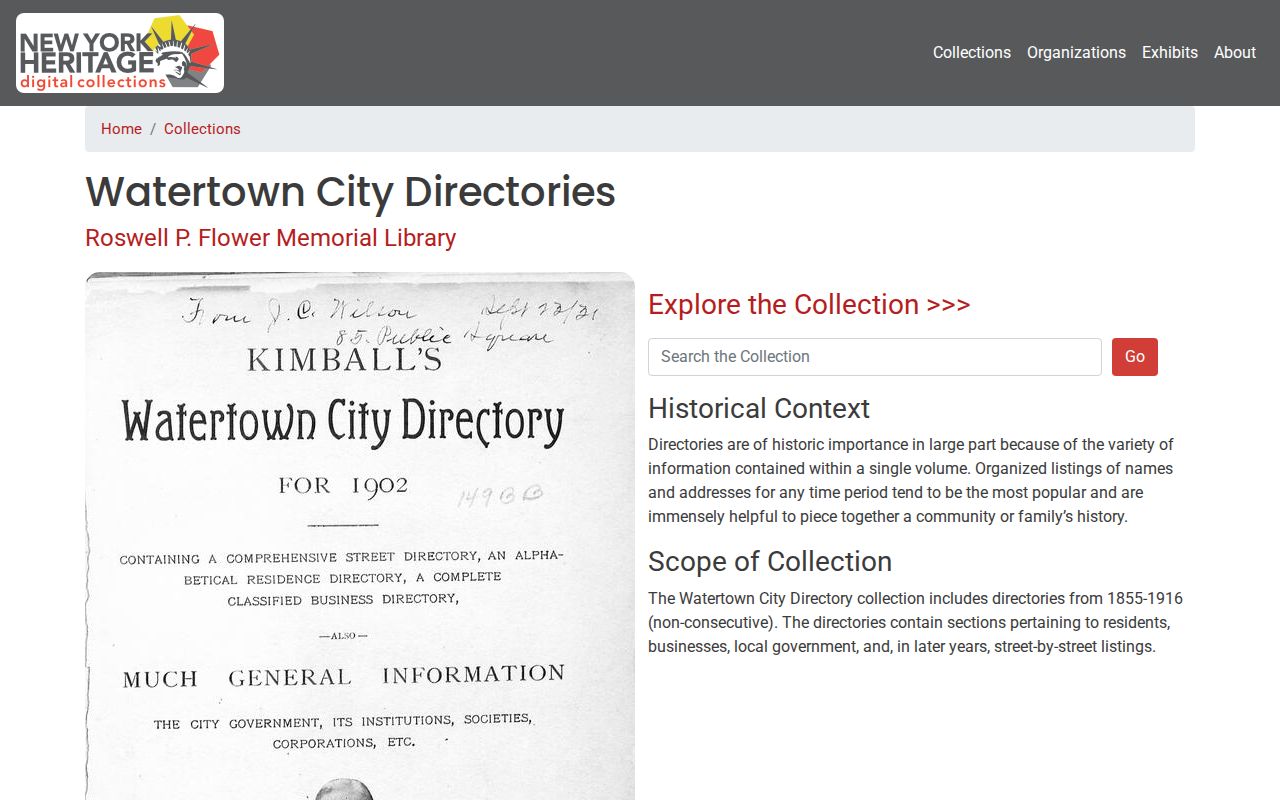
The digitized view is valuable because punctuation, abbreviations, and page layout matter as much as the OCR text when reading old city directories.
Note: The known run has gaps, so a missing name in one year does not establish that a household had left the area.
Le Ray City Directory Collection Timeline
The available directory chronology is regional, but it gives a useful date frame for a Le Ray research lead. It also shows why the date printed on a particular volume matters more than a broad claim that a directory series covers every year.
- 1840: the NY Heritage item inventory exposes a Watertown directory title for this year.
- 1855: the collection summary begins its non-consecutive Watertown run.
- 1902: a J.C. Kimball volume identifies a comprehensive street directory and alphabetical residence directory.
- 1916: the listed digitized run reaches this title, with no claim of a continuous annual series.
Those dates organize a search, but they do not create a Le Ray series where none was confirmed. Keep the exact volume and its printed locality attached to every extract.
Le Ray City Directories Need Place Checks
Watertown is the county seat, while Le Ray is a separate town with Evans Mills, Calcium, Le Raysville, Black River-area, and Fort Drum context. That geography explains why a Watertown directory can be a strong regional clue and still need confirmation. A street label, surname, or occupation may point toward a family trail, but the printed municipality and the civil town are not interchangeable. Fort Drum-related postal and privacy rules also should not be inferred from an off-post directory address.
Use the Town of Le Ray history page to place a local lead in the town's setting, then use the county parcel or land-record route for an address-level check. The town was established in 1806, while the county deed series reaches back to 1793. That difference is useful when a property trail predates the town's present organization.

The town history source gives geographic context, but a library directory entry remains a lead until a record with the right place and date supports it.
Reading a Le Ray City Directory Line
A directory line is compact evidence. The 1902 Watertown volume contains an alphabetical residence directory, a comprehensive street directory, a business directory, government material, and institutions. Sample lines can show a name, a spouse or relationship in parentheses, an occupation, a business address, a residence, rooms or boarding notation, and a widow marker. Copy each part exactly before expanding it. The printed abbreviation key and the page image are safer than an OCR guess.
| Name | Usually the listed person, sometimes followed by a spouse or relationship in parentheses. |
|---|---|
| Work or business | A dated occupation or business location, not a statement about the person today. |
| Residence | Often marked by h for house or res. for residence. |
| Rooms or boarding | rms. or bds. can describe rooms or boarding rather than a full household. |
| Widow notation | wid. is a relationship clue that should be checked against a dated record. |
- Criss-cross directory
- A street-order section that lets the reader approach an address rather than a surname. The 1902 volume has this kind of street directory.
- Householder entry
- The person under whom a household may be indexed. Other members may appear under a spouse, widow, boarder, or roomer notation.
- Abbreviation key
- The publisher's guide to shortened words. Read the scanned key before treating an abbreviation or asterisk as a fact.
Note: Transcribe the original mark first. An expansion can be useful for notes, but it should not replace the wording that appears in the volume.
Flower Library and Le Ray Directories
Flower Memorial Library is the practical local-history escalation point for a Le Ray city directory question. Its genealogy department focuses on Jefferson County and adjacent counties, offers a microfiche reader, and can help with local newspapers, obituary leads, and historical indexes. The department lists Monday through Saturday hours of noon to 4, but those operational details should be checked before a visit. In-house searches are described as free; copies are listed at $0.20 per page plus postage.
The Flower Memorial Library genealogy service accepts a detailed mail request with a self-addressed stamped envelope, and also identifies email and telephone routes for brief questions. Give the staff a surname, given name, town or place, approximate year, and record type. A narrow request is more likely to find a relevant microfilm or directory entry than a broad request for every record about a person.
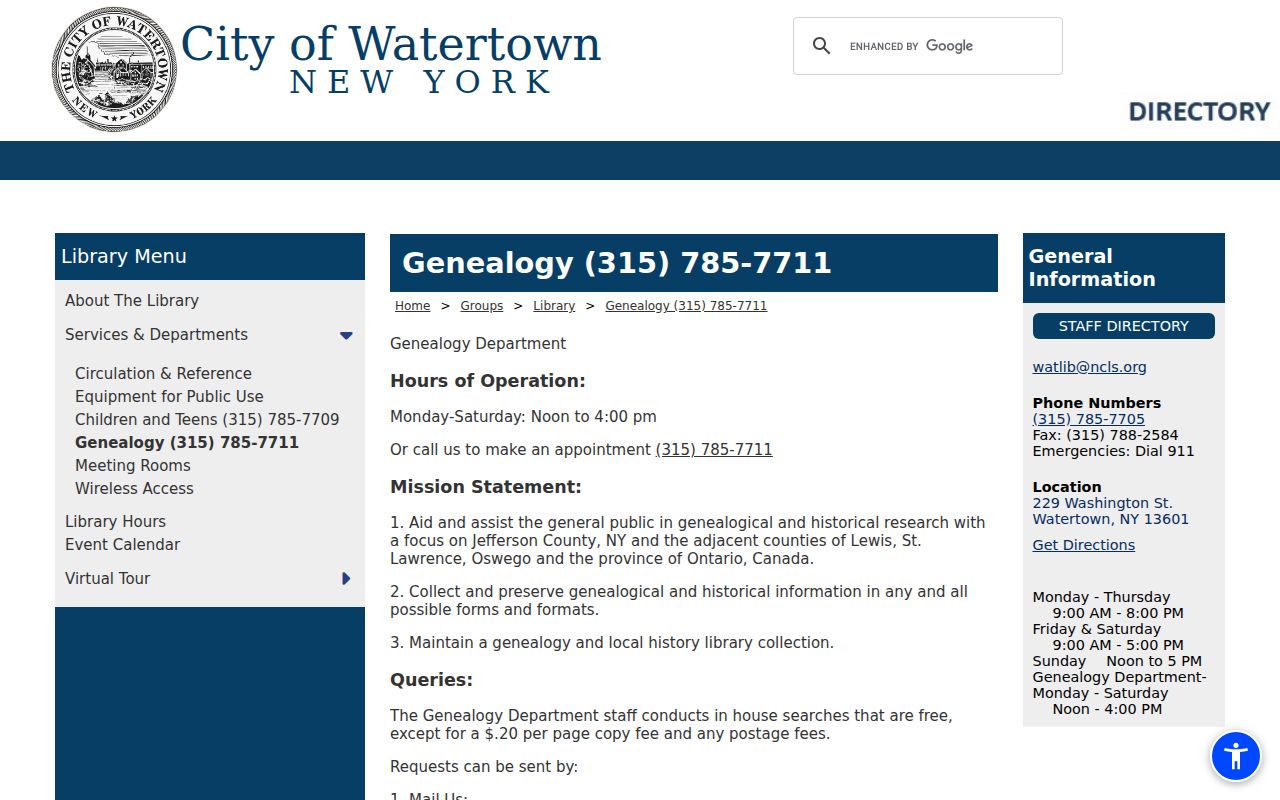
Flower is also the named nearby route when a directory lead needs an obituary, newspaper, vital-index, or microfiche follow-up.
Note: Confirm current desk hours and copy charges before traveling or placing a long-distance request.
Le Ray Directory OCR Needs the Scan
The 1902 directory preface says its street section aimed to give streets, intersecting streets, correct house numbers, and occupants, but it also warns that errors can remain. That warning matters. OCR may blur asterisks, initials, punctuation, and short address marks. One sample includes Peter Doner with Mary, a laborer, at 37 LeRay. It is a dated Watertown directory lead, not proof that the person was a Town of Le Ray resident. Read the original page and compare the location with another source.
For a historical household trail, save the title, year, page, printed spelling, and image reference. Keep an alternative spelling in a separate note. Do not normalize away a married name, an initial, or a possible OCR error before checking the next directory year, the federal census, a deed, or an eligible vital-record index.
Tracing Le Ray City Directory Households
City directories work best as an interval record between federal census releases. A census is a household snapshot subject to the 72-year public-access rule, while a directory captures a publisher's separate list for a particular date. Pairing them can expose an address change, a spouse notation, or a change in how a name was recorded. It cannot prove that every person at the address appears in both sources.
- Choose the closest dated directory and transcribe the name, address, relationship marks, and occupation exactly.
- Check the next available volume, recognizing that the Watertown run is non-consecutive.
- Use the street section in the relevant volume when an address appears, then retain the printed place name.
- Pair the directory interval with the available federal census and compare household members, ages, and place.
- Use a deed, eligible vital index, obituary lead, or county record to test a move, death, or family connection.
A person can vanish from a directory because of a move, death, a listing choice, or a gap in the run. The Town of Le Ray resident lookup route is better for confirming a current official record; the historical volume should remain a dated part of the trail.
Le Ray History Beyond City Directories
When the printed volumes stop short of a Le Ray question, museums provide local context that a directory does not. The LeRay Historical Museum in Evans Mills presents material on local industry, education, military history, and notable residents. It is a good contact for a precise local-history question, especially when the address, approximate time, and collection topic are already known. Museum context should be recorded with its exhibit or collection title and date, then checked against a records custodian for factual claims about a household.
The LeRay Historical Museum is distinct from the Jefferson County Historical Society at Paddock Mansion in Watertown. The historical society offers county collections and directs genealogy questions to Flower Library, which keeps the roles clear: museum context in one place, directory and microfiche research in another.
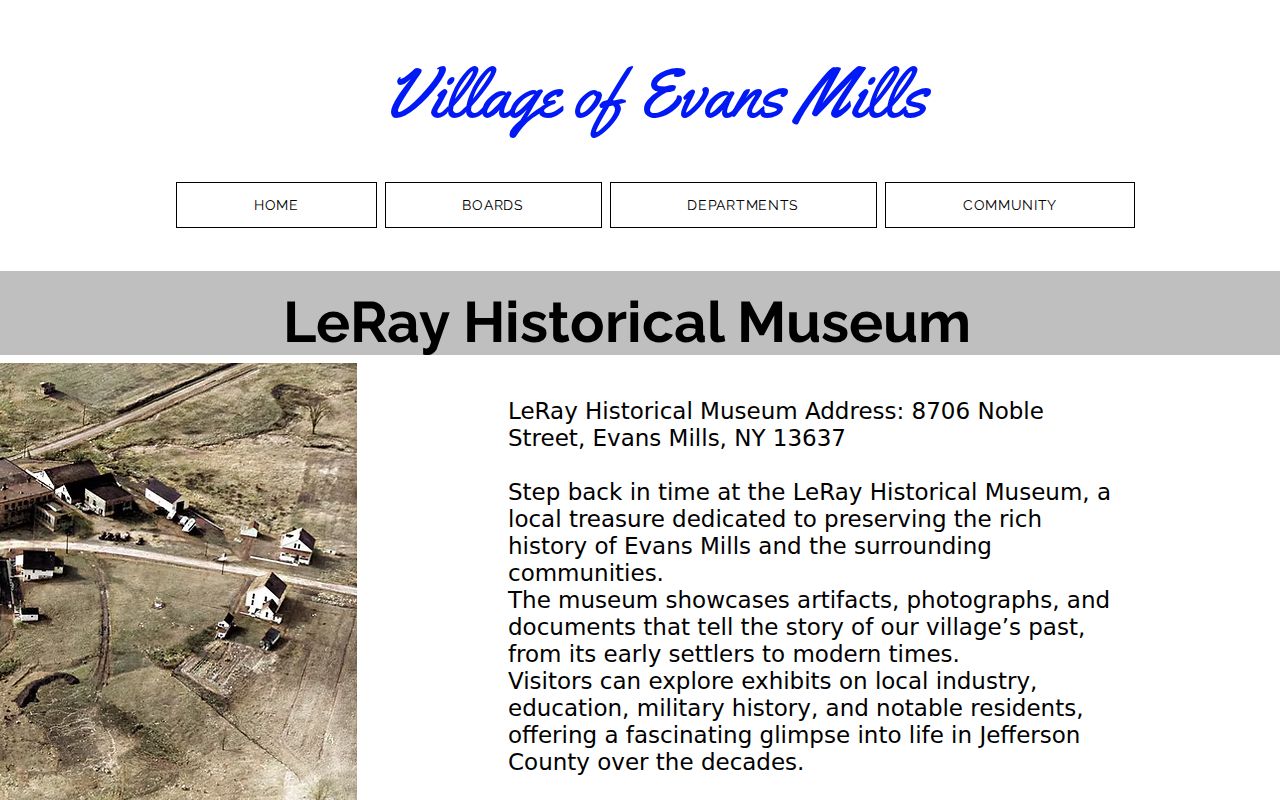
Using the museum alongside Flower Library gives a historical inquiry both local context and a documented research path.
Le Ray City Directory Leads Need Proof
NYS Archives indexes and Flower Library microfiche extend the historical trail without replacing the underlying record. Outside New York City, the documented microfiche spans births from 1881 to 1937, marriages from 1881 to 1960, and deaths from 1880 to 1960. An index can supply a name, date, place, and certificate number. It is not a certificate. Eligible copies follow the custodian's rules, including the state's genealogy waiting periods and direct-line exception.
Jefferson County's naturalization list is another useful index. Its rows retain family name, given name, date, code, and file number; the code can be D, N, O, MP, OS, TR, or R. Carry that code and file number into a narrowly dated Records Management request rather than assuming the index reveals the whole packet. This is especially helpful when a directory spelling and a later record spelling do not match.
Note: Preserve each source's date and place. A regional city directory, an archive index, and a recorded document have different strengths and should not be treated as the same proof.